

Artificial intelligence is no longer just a tool for automating basic administrative tasks; it is a force reshaping how providers document, code, and submit claims. According to the AMA's 2026 Augmented Intelligence Research survey, more than 80% of physicians now use AI in their clinical practice, double the share reported just three years prior, with documentation and coding support among the most common applications.
This shift has introduced a new category of billing inaccuracy, where errors and inflated claims are faster to generate, harder to detect, and more expensive to recover than anything traditional payment integrity programs were designed to handle.
Health plans looking to stay ahead and protect the payment cycle must shift their strategy and counter current AI tools with more targeted AI solutions.
AI is changing how providers code, and not always accurately
As providers adopt AI-assisted coding to reduce burnout and optimize revenue capture, automation has made billing inaccuracies systemic rather than incidental. Ambient AI documentation tools are being widely implemented as a mechanism to convert clinician-patient encounters into structured medical notes.
Provider demand for these tools is clear, with investment in ambient clinical documentation now representing $600 million in annual AI spending, while coding and billing automation accounts for an additional $450 million, with both categories specifically designed to optimize reimbursement and recover revenue.
At best, AI coding engines optimize clinical documentation. At worst, they capture every possible billable diagnosis without considering payer policies, coverage guidelines, or medical necessity. This creates a growing mismatch between what providers document and what payers can legitimately reimburse, shifting the burden of verification downstream to payment integrity teams.
DRG complexity and the documentation integrity problem
The integration of AI into clinical workflows has inadvertently turned documentation into a high-speed engine for diagnosis-related group (DRG) optimization. AI tools can be leveraged, whether by design or through algorithmic bias, to hit the precise minimum criteria required to trigger higher-reimbursement tiers.
The most prominent example of this occurs in the management of sepsis-related DRGs. AI tools frequently surface transient vital sign and laboratory abnormalities such as a brief tachycardia, a mild leukocytosis, or a single lactate elevation, and prompt providers to escalate documentation from "sepsis" to "severe sepsis" or "septic shock." The clinical reality may be a patient meeting only SIRS criteria, with a known source of infection, responsive to initial fluids and antibiotics, and without true end-organ dysfunction.
But once severe sepsis is captured as a secondary diagnosis, the claim shifts to a higher weighted DRG, leading to a reimbursement differential that can exceed $5,000–$8,000 per case depending on the payer and geography. Yet this shift often occurs without a corresponding increase in the actual intensity of resources utilized.
This pattern has placed a target on sepsis claims. The Office of Inspector General has intensified its scrutiny of these specific DRG shifts, noting that hospitals frequently report sepsis—the highest-severity level—when clinical indicators only support localized infections or systemic inflammatory responses.
As instances like the sepsis-related upcoding challenge become more prevalent, the financial and regulatory risk for health plans grows. AI-driven nudges make it easier for providers to execute these types of high-value documentation patterns at scale, requiring finance and clinical leaders to look beyond the presence of words on a page and evaluate the underlying clinical validity of each claim.
Why traditional AI upcoding detection methods can't keep up
Legacy claims engines, the rules-based adjudication and editing systems that most health plans have relied on for decades, are programmed for static logic. This leaves them blind to the synthesized clinical narratives used to justify automated upcoding. AI-assisted upcoding is neither linear nor predictable; it adapts to clinical guidelines in real-time to produce documentation that appears clinically coherent.
When an AI tool subtly steers a narrative to satisfy high-severity clinical indicators, it does so with a level of nuance that traditional rules simply cannot detect.
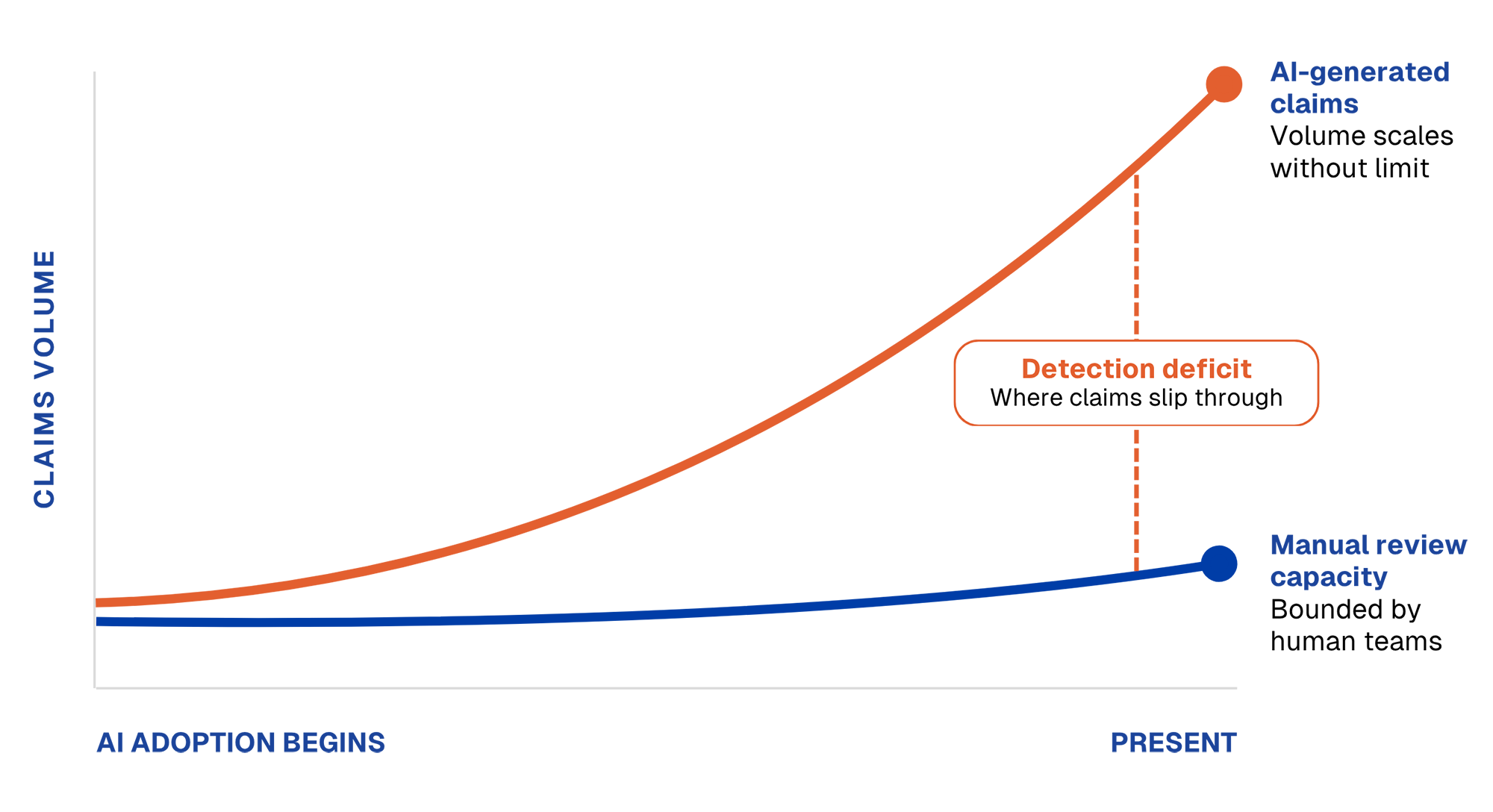
This shift has transformed billing inaccuracies from occasional human errors into systemic, automated optimizations. Consequently, the volume and speed of these AI-generated claims are outpacing the capacity of manual clinical reviews, leaving health plans with a critical gap in detection.
The case for AI-powered payment integrity
The industry has entered what Health Affairs researchers describe as an "AI arms race." While this algorithmic friction begins in utilization review, its financial fallout lands directly on payment integrity teams. As providers deploy generative AI to maximize efficiency and reimbursement, health plans face an unprecedented wave of hidden administrative waste.
To counter algorithmically optimized billing, payers must move beyond the automation that has recently sparked regulatory pushback. The most effective response is a transparent, AI-powered payment integrity program that analyzes documentation against clinical policy and scales with claims volume. Alaffia’s platform meets this challenge by analyzing clinical narratives for inconsistencies and ensuring compliance through highly configurable AI agents.
Alaffia's technology applies a plan's specific guidelines across payment integrity, utilization management, and appeals to ensure reimbursement aligns with actual criteria. Our AI agents autonomously digitize and standardize unstructured clinical data, mapping it to structured claims data to secure deeper savings and faster turnaround times.
The result is measurable, with health plans using Alaffia's platform seeing a 20x increase in throughput and a 5x return on investment, delivering the kind of performance that reactive, rules-based programs simply cannot match.
AI-driven billing inaccuracies are a present, accelerating reality, and health plans that delay modernization will remain in a permanent recovery posture, chasing overpayments that legacy systems were never designed to detect.
Proactive health plans are already shifting strategy. They recognize that an era of automated billing offense requires an equally sophisticated defense to protect payment accuracy and medical loss ratios.
To learn more about how Alaffia’s agents are helping health plans supercharge their claims operations, schedule a demo with our team.


Drive health plan affordability with Alaffia
Find out what our AI agents and managed services can do for your plan.